Virtual Harvester
Note
TODO: WORK IN PROGRESS
IVSurface - Transition-Cutout
The analog frontend needs a bit more than a cycle to handle large 5 V transitions. Solar cells add extra capacitance to the frontend and make the transition slower.
The virtual harvester can cutout these transition periods to avoid recording unwanted capacitive effects.
Using the cutout_cycles and enable_automatic_cutout parameters is mostly meant to avoid post-processing before using the traces for emulation.
To avoid interfering with the window_size-calculations, this cutout happens at the beginning of the IVCurve-window and will influence V_OC or I_SC values (depending on rising parameter).
Automatic mode works by
gets activated during reset of voltage-ramp
hold the previous adc-samples during that transition
check if transition is complete to disable cutout (i.e. if rising of voltage stops for a falling ramp)
compensation for noise via
cutout_cycles-parameter acting as buffer (forgiving that number of cycles that can violate condition before ending the cutout)
Example 1 - Solar with Rising Ramp
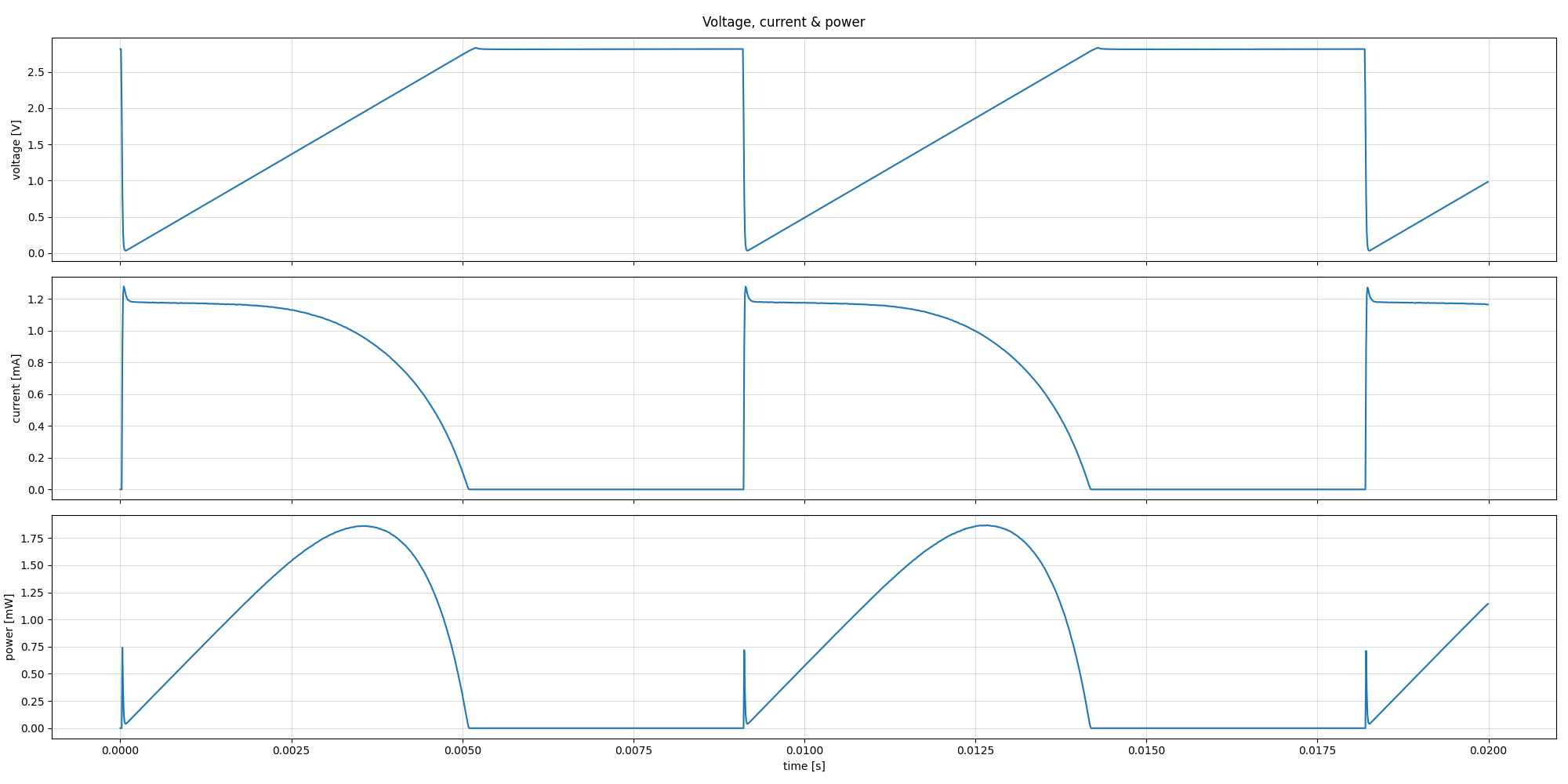
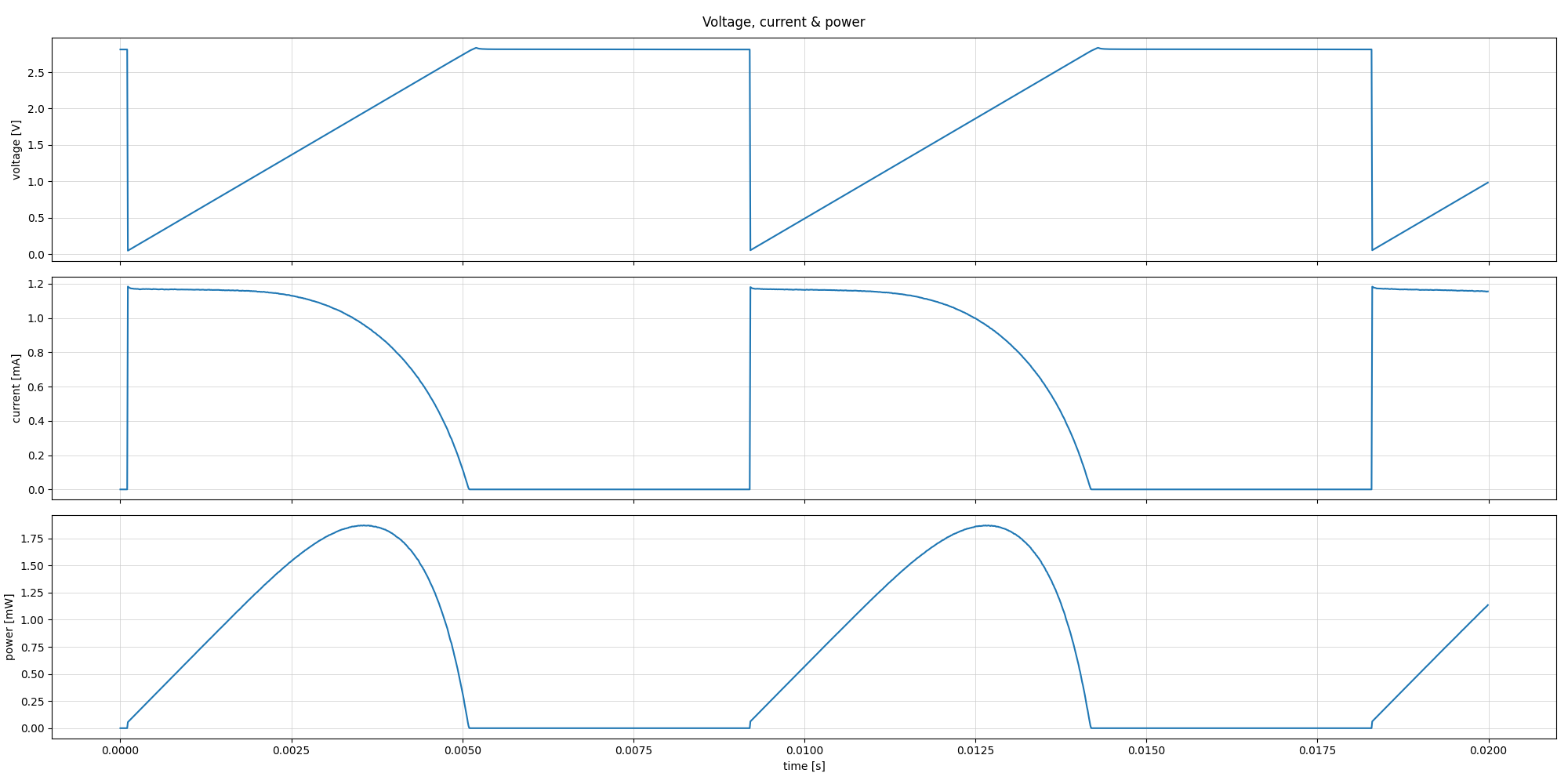
After restarting the voltage ramp (jumping down to 0 V), the current is higher than it should. As a result, the power-trace has an undesired spike. This behavior varies with the cell-type and illumination and hints at some capacitive load on the cell. Note that the 0 V level (I_SC) is lost for this mode, because it is hidden in the transition-period or the cutout.
There is another unwanted effect that raises the Voltage slightly higher when the ramp crosses V_OC. Due to the design of the harvesting-circuit the recorded voltage shouldn’t rise higher than V_OC.
Without cutout:
With automatic cutout (+3 buffer cycles):
Example 2 - Solar with Falling Ramp
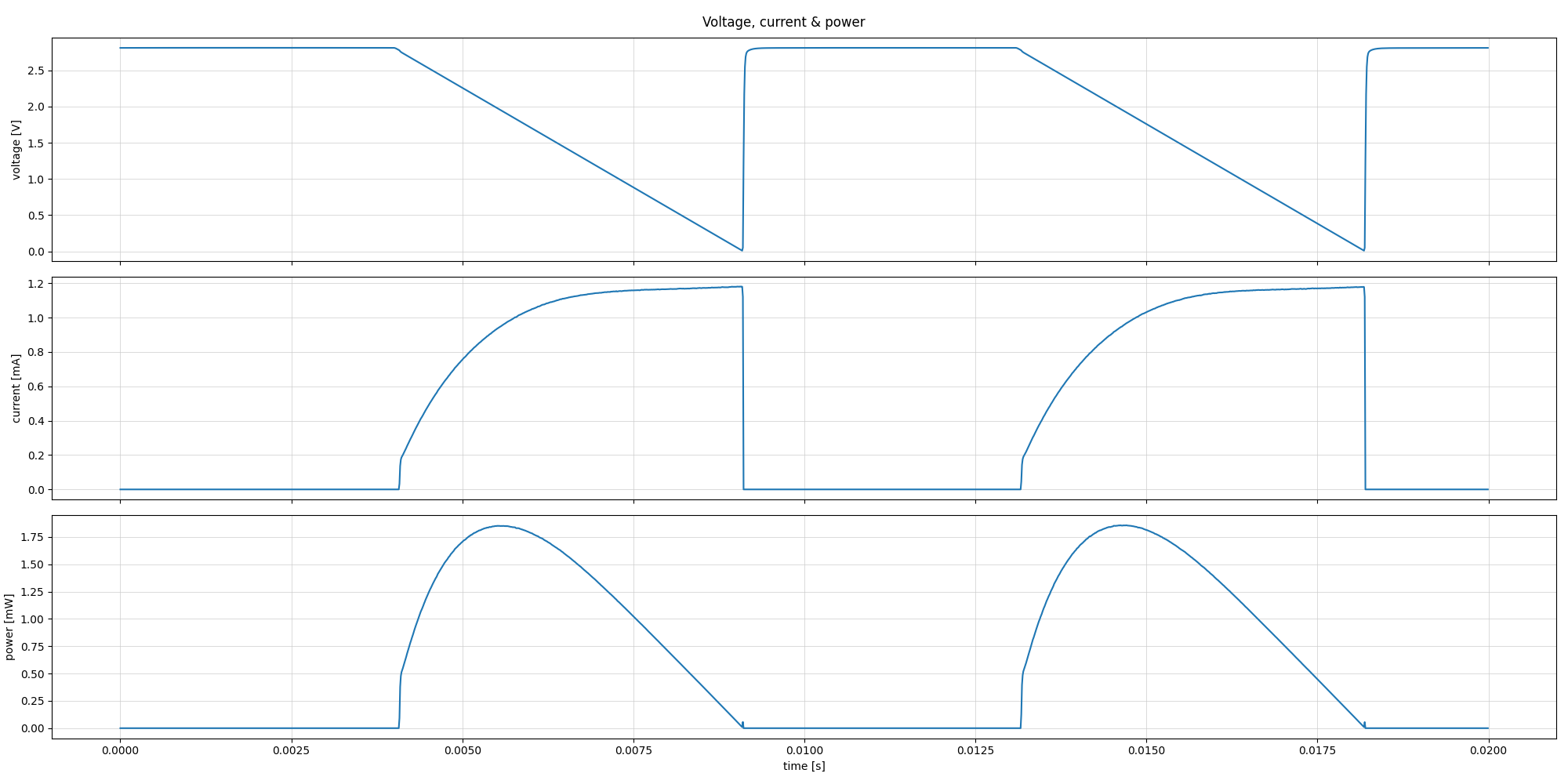
After restarting the voltage ramp (jumping up to 5 V), the voltage step is rounded off. In addition, a small spike can be found in the power-trace. The transition-phase (or cutout) usually falls in the part of the voltage ramp that is above the V_OC, so no information is lost.
Without cutout:
With automatic cutout (+3 buffer cycles):
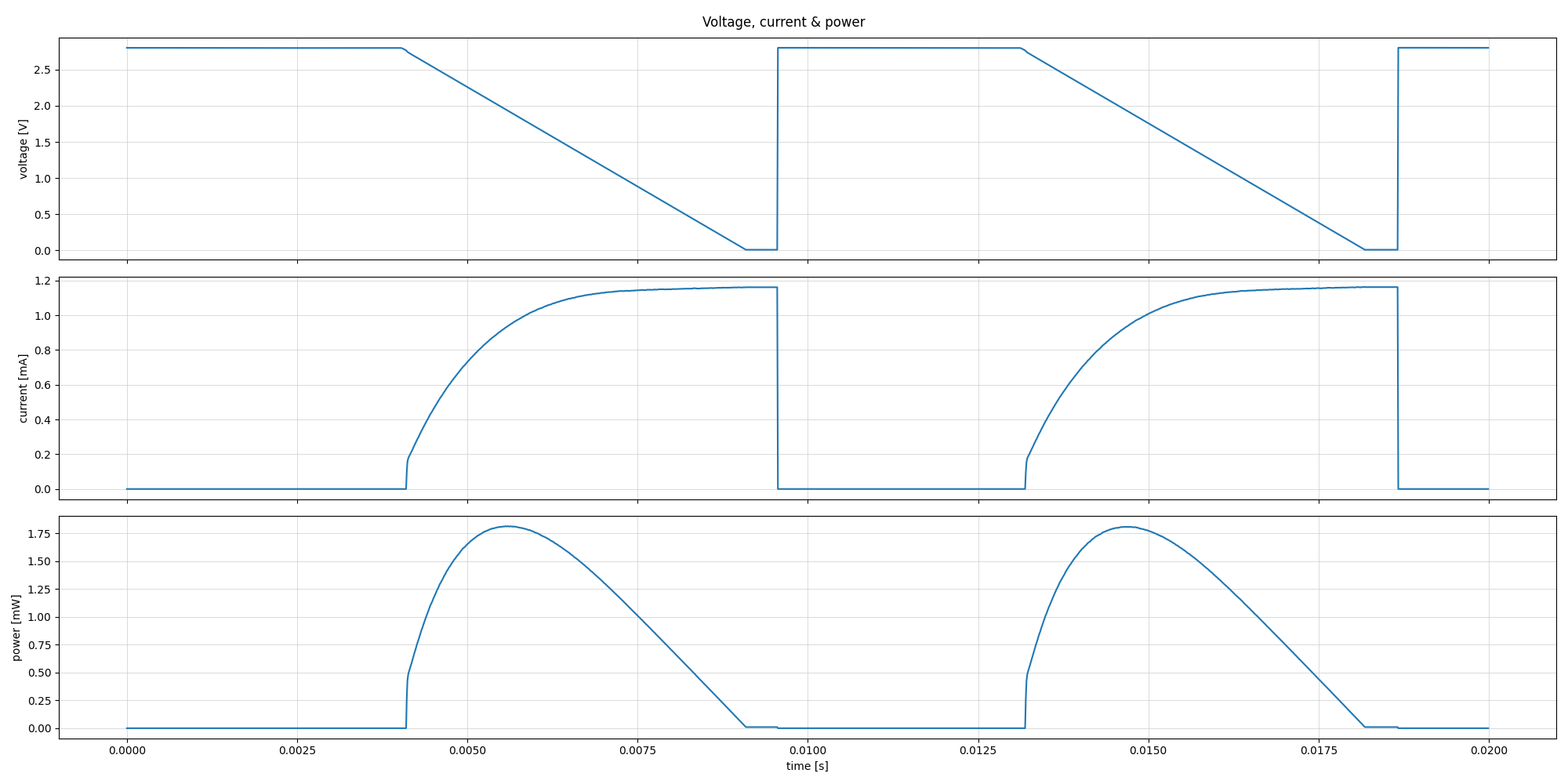
Note that there is another unwanted effect when the falling voltage ramp crosses V_OC, the current stays lower than expected for the first samples.